
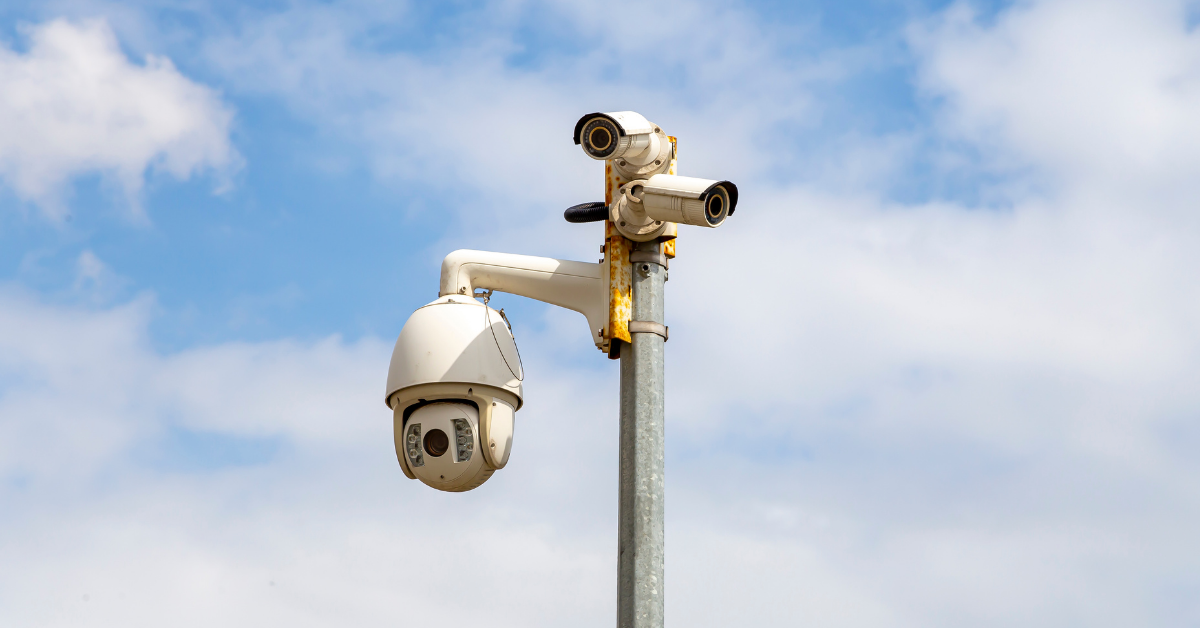
Cargo yard security protects the trailers, containers, vehicles and gate movements outside a logistics facility. For Ontario operators, an effective perimeter strategy combines controlled vehicle entry, license plate recognition, fence-line detection, lighting, camera coverage and documented trailer checks. SecurU designs these systems for logistics yards across the GTA and Southwestern Ontario.
The distinction matters. A warehouse can have strong doors, alarms and employee access control while its drop lot remains exposed to unauthorized vehicles, fence breaches or trailers leaving under questionable credentials.
SecurU has served Ontario businesses for more than 30 years from its Puslinch office, designing, installing, certifying and monitoring commercial security systems in-house. For logistics yards in Mississauga, Caledon, Milton, Guelph, Cambridge, Kitchener-Waterloo, Burlington, Hamilton and surrounding regions, the assessment must begin outside the building envelope.
Is trailer and cargo yard theft a serious risk in Ontario in 2026?
Yes. Ontario remains Canada’s most concentrated cargo-theft region, particularly around the GTA’s warehouse, trucking and distribution corridors.
Équité Association, which maintains Canada’s national cargo-theft database, recorded approximately 1,601 thefts involving tractors, trailers and cargo in Ontario during 2025, with Peel Region and the wider GTA accounting for a significant share of that volume. Nationally, trailer theft alone climbed to roughly 970 incidents in 2025, up from about 570 in 2024 — a trend Équité’s investigators describe as having nearly doubled year over year (Truck News, Feb. 2026).
The geographic concentration is not new. Équité’s inaugural Cargo & Heavy Equipment Theft Trend Report, covering 2019 through 2023, found that stolen Canadian trucks, trailers and cargo loads were worth more than $531 million, with over $239 million never recovered. Mississauga, Brampton, Vaughan and Toronto were four of the report’s top five national cargo-theft hotspots, alongside Montreal. Équité has also noted that cargo theft is a chronically underreported crime — companies often absorb a loss quietly rather than file a claim, whether for reputational reasons or because the loss falls under an insurance deductible — so reported totals should be read as a floor, not a full count.
Recovery has not kept pace with the increase in theft. Équité reports that the national cargo recovery rate fell from 13 percent in 2024 to 9 percent in 2025, while the trailer recovery rate dropped from 64 percent to 44 percent over the same period. For an Ontario operator, the practical implication is direct: once a loaded trailer leaves the yard, the odds of getting it — or the freight inside it — back are falling. That shifts the value of a security investment toward prevention at the gate and fence line, rather than recovery after the fact.
These figures do not mean every Ontario yard faces the same risk. They do mean that logistics operators should assess the yard as a separate security zone rather than assuming that a protected warehouse automatically creates a protected property.
Why do thieves target trailer yards instead of warehouse buildings?
Thieves target trailer yards because the valuable asset may already be packaged, mobile and temporarily unattended.
A loaded trailer in a staging lane or drop lot can represent a simpler target than cargo stored inside a monitored warehouse. The offender may not need to enter a building, find the correct inventory, defeat internal controls and move goods through a dock. In some incidents, the trailer itself can be removed by connecting a tractor and exiting through an uncontrolled or poorly supervised gate.
Several operating conditions can increase that exposure:
- Drop-and-hook operations leave trailers staged without a dedicated driver.
- Loaded trailers may remain outdoors overnight, over a weekend or during a scheduling delay.
- Multiple carriers and temporary drivers create a high volume of unfamiliar vehicles.
- Gate personnel may rely on visual recognition, paper records or verbal instructions.
- A following vehicle may enter before an automated gate closes, a practice known as tailgating.
- Trailer movements may be recorded in one system while camera footage is stored separately.
- A missing trailer or broken seal may not be identified until the next scheduled yard check.
Équité specifically recommends avoiding unattended loaded trailers where possible and using secure, fenced, well-lit parking areas with surveillance. It also recommends high-quality locks and seals, electronic tracking and kingpin locks for trailers that must be staged in higher-risk locations. A kingpin lock prevents an unauthorized tractor from coupling to the trailer.
CargoNet’s 2024 North American analysis reinforces the trend. It recorded 3,625 supply-chain crime incidents across Canada and the United States — a 27 percent increase over 2023 — with the average loss value per theft climbing to $202,364 (Verisk CargoNet, Jan. 2025). The broader pattern matches what Équité is tracking in Ontario: cargo crime is becoming more frequent and more costly, not less.
The practical lesson is straightforward: the point of loss is not always the warehouse. It may be the fence opening, gate lane, trailer row or administrative handoff that allowed the wrong tractor to reach the right load.
For building-interior risks such as dock-door controls, employee access and inventory shrink, see “Securing Warehouses in Ontario in 2026” and “Ontario Logistics & Distribution Facility Security in 2026.”
How is cargo yard security different from building security?
Cargo yard security manages vehicle movement, open space and movable assets, while building security manages people, doors and defined interior rooms.
A building presents relatively fixed control points. Employees enter through designated doors. Sensitive rooms can be locked. Cameras can cover hallways, receiving areas and inventory zones with controlled lighting and predictable distances.
A yard is different operationally:
| Building security | Cargo yard security |
| Controls people entering doors | Controls tractors, trailers, drivers and service vehicles |
| Uses employee badges and door readers | Uses driver credentials, carrier authorization and gate controls |
| Protects rooms and fixed assets | Protects movable trailers, containers and equipment |
| Has predictable indoor lighting | Must operate through darkness, glare, weather and long distances |
| Detects door openings | Must detect gate tailgating and fence-line activity |
| Reviews indoor incidents | Must reconstruct vehicle arrival, trailer movement and departure |
This changes both the technology and the workflow.
A camera that is suitable for a warehouse corridor may not capture a readable licence plate from a moving tractor at night. An employee badge system may confirm who entered the office but not whether a third-party carrier was authorized to collect trailer 4027. A standard motion alert may also generate excessive activity in a yard where trucks, wildlife, weather and vegetation are continually moving.
Effective perimeter security must therefore be designed around yard lanes, fence lines, operating hours, trailer inventory and carrier processes rather than copied from the building system.
What should an Ontario cargo yard security system include?
A strong system uses layered controls so one missed check does not automatically result in an undetected loss.
Controlled entry and exit lanes
Every vehicle should enter and leave through a defined control point wherever the property layout allows it.
Gate design should separate inbound and outbound traffic, limit opportunities to drive around the barrier and provide enough stopping distance for credential checks. Vehicle loops, barrier arms, intercoms and camera views should work together rather than as independent devices.
Exit controls are equally important. Recording entry without verifying departure can leave operators unable to answer basic questions after an incident:
- Which tractor entered?
- Which driver was authorized?
- Which trailer did the tractor leave with?
- Was the trailer seal visible?
- Did another vehicle follow through the gate?
- Was the movement expected at that time?
For busy GTA and Southwestern Ontario yards, the goal is not to slow every movement. It is to create a reliable record of exceptions while allowing authorized carriers to move efficiently.
Gate access control for drivers and carriers
Driver gate access should be managed separately from employee building access.
A carrier driver may need access to one yard, during one collection window, for one purpose. That does not mean the driver should receive the same credential or system permissions as an employee entering the warehouse.
A managed platform such as Kantech hattrix can support centralized credential administration across multiple locations. Hattrix is a hosted access-control platform that allows authorized managers to issue, change and revoke access without maintaining a separate on-site server at every facility.
Depending on the site workflow, gate credentials may include:
- Mobile credentials
- Assigned fobs or cards
- Time-bounded temporary credentials
- Intercom-assisted remote entry
- Pre-authorized carrier access schedules
- Credentials limited to a particular site or gate
Temporary credentials should expire automatically after the approved collection period. This reduces the risk of old carrier codes, shared access methods or previously issued credentials remaining active indefinitely.
Do I need gate access control if my warehouse already has building access control?
Yes, if vehicles, trailers or third-party drivers can enter the yard independently of the building.
Building access control answers, “Who may enter this door?” Gate access control answers, “Which vehicle and driver may enter this property, at what time, for which movement?” Those are different operational questions.
A logistics facility may have tightly controlled employee entrances while allowing drivers to enter through a manually opened gate after providing a company name or trailer number. That creates a gap between physical access and shipment authorization.
Gate access should be tied to a defined driver or carrier record whenever practical. It should also generate an event that can be matched to video, licence-plate data and the yard-management process.
The two systems can still be integrated. For example, the operator may use a single management structure to review both building and gate events, while applying different permissions, schedules and escalation rules to each.
What is LPR and how does it stop yard theft?
Licence plate recognition, or LPR, uses a purpose-designed camera and analytics to capture and index vehicle licence plates as vehicles pass a defined point.
LPR does not physically stop a theft by itself. It strengthens prevention and investigation by creating a searchable record of vehicles entering, circling or leaving a property.
At a cargo yard, LPR is most useful at:
- Inbound gate lanes
- Outbound gate lanes
- Secondary entrances
- Approaches to trailer staging areas
- High-risk access roads
- Locations where vehicles could bypass the main gate
An effective gate record may combine the plate image, vehicle overview, time, lane and related access event. This allows an operator to compare the vehicle that presented a credential with the vehicle that actually entered.
LPR can also help identify exceptions such as:
- A plate not associated with an approved carrier
- A vehicle arriving outside its expected window
- The same plate appearing repeatedly without a scheduled pickup
- A vehicle entering through one lane and leaving with an unexpected trailer
- A second vehicle following closely behind an authorized tractor
Illustra AI-enabled cameras and Alarm.com business video can support object-aware detection and searchable video workflows where appropriate. Object-aware analytics distinguish relevant activity, such as a person or vehicle, from general scene motion. The specific camera, lens, mounting height and lighting must still be selected for the lane conditions. “AI camera” is not a substitute for proper placement.
How should cameras protect fence lines and trailer staging areas?
Cameras should detect approaches and movement patterns before a person reaches a trailer, not merely record the trailer after it has disappeared.
Fence-line coverage should focus on likely breach points, including:
- Areas hidden from the building
- Fence sections bordering roads, rail lines or neighbouring lots
- Drainage areas and changes in grade
- Corners obscured by parked trailers
- Utility corridors
- Sections near trees, stored materials or climbable objects
- Emergency gates and infrequently used entrances
Long-range views can provide situational awareness, but identification generally requires closer coverage at predictable choke points. A wide camera may show that a vehicle entered a trailer row without capturing the plate or distinguishing features required for an investigation.
Analytics can help detect line crossing, loitering and person or vehicle activity in restricted zones. A line-crossing rule creates an alert when a defined object crosses a virtual boundary in a specified direction. Loitering analytics identify an object that remains in a selected area longer than the established threshold.
The rules must reflect actual operations. A detection zone that includes an active public road, moving branches or routine trailer traffic will generate excessive alerts and eventually be ignored.
What role do fencing, lighting and fence-line detection play?
Fencing, lighting and electronic detection create the physical conditions that make cameras and response procedures more effective.
Fencing should establish a clear boundary, guide vehicles toward controlled gates and reduce easy access to trailer rows. Operators should regularly inspect for cut sections, gaps beneath fencing, damaged posts, unsecured gates and objects stored close enough to assist climbing.
Lighting should provide consistent coverage at gate lanes, fence approaches and trailer rows without creating severe glare or dark shadows. Camera performance should be tested under actual night conditions, including headlights, wet pavement, snow and changing trailer positions.
Electronic detection may include analytic camera rules, gate contacts and other perimeter sensors selected for the environment. The purpose is to identify unusual activity early enough for a response, not simply preserve footage after the loss.
Where alarms require verification or escalation, SecurU can incorporate AG Chat as a smarter monitoring and response layer. AG Chat should be treated as part of the response process rather than a replacement for physical barriers and clear yard procedures.
For the full monitoring workflow, see “AG Chat: Reduce False Alarms with Smarter Monitoring.”
How should trailer seals and yard checks be documented?
Trailer seal checks should create a time-stamped record that can be tied to the corresponding trailer and camera footage.
A seal is only useful if the organization knows:
- Which seal number was applied
- When it was checked
- Who performed the check
- Where the trailer was positioned
- Whether the seal appeared intact
- What action was taken when a discrepancy was found
A practical yard-check workflow can follow five steps:
1. Confirm the trailer number and assigned location.
Record whether the trailer is loaded, empty, awaiting pickup or out of service.
2. Verify the seal number and visible condition.
Do not record only “seal checked.” Capture the actual identifier and any visible damage.
3. Record the check time and employee or contractor.
The entry should establish accountability without relying on memory or handwritten notes that cannot be searched.
4. Create a camera bookmark for exceptions.
A bookmark is a saved video reference tied to a specific time or event. Broken seals, moved trailers, unfamiliar tractors or damaged fencing should be bookmarked immediately.
5. Escalate discrepancies before the trailer moves.
Operations, loss prevention and the carrier should have a defined process for stopping, inspecting or documenting the load.
Camera bookmarks make later review faster. Instead of searching hours of footage, an investigator can open the saved event and then work backward to identify when the trailer, seal or surrounding activity changed.
How can operators assess and prioritize yard-security gaps in 2026?
Start by following the actual movement of a trailer from arrival to departure, then prioritize fixes that close the gaps a real assessment turns up rather than adding general-purpose cameras first. A useful perimeter assessment should answer:
- Can a vehicle enter behind an authorized tractor before the gate closes?
- Are inbound and outbound plates captured clearly during the day and at night?
- Is every active gate monitored, including emergency and secondary gates?
- Can temporary driver credentials be revoked automatically?
- Are trailer rows visible when the yard is full?
- Are fence sections obscured by trailers, vegetation or neighbouring structures?
- Are loaded trailers placed in the most protected areas?
- Are seal checks documented consistently?
- Can a gate event, LPR record and video clip be reviewed together?
- Who receives an alert when a person crosses the fence line after hours?
- Is there a defined response when a trailer is moved unexpectedly?
- Can the system scale across multiple Ontario locations?
This assessment should be completed under real operating conditions. A daytime walkthrough of an empty yard will not reveal the same problems as an overnight review with full trailer rows, snow, rain, headlight glare and third-party drivers arriving at shift change.
Where to start: the highest-value fixes are usually operational, not cosmetic. A single controlled vehicle path, plate-and-vehicle capture at every gate, time-bounded driver credentials, and gate events linked to searchable video. Lighting upgrades at gates, seal-check points and fence approaches typically come next, since every other control depends on footage that’s actually usable at night.
SecurU can design these controls as a coordinated system rather than dividing responsibility among a gate contractor, camera vendor, access-control company and separate monitoring provider. The system is designed, installed, certified and monitored in-house, giving Ontario operators one point of accountability from the initial yard assessment through ongoing service.
Frequently Asked Questions
Is trailer and cargo yard theft actually a problem in Ontario?
Yes. Équité Association recorded approximately 1,601 tractor, trailer and cargo thefts in Ontario during 2025, with Peel Region and the GTA representing a significant share of that total. Its broader reporting also names Mississauga, Brampton, Vaughan and Toronto among Canada’s top cargo-theft hotspots, and found that national trailer theft nearly doubled between 2024 and 2025.
What is the difference between perimeter security and building security?
Perimeter security controls property boundaries, gates, vehicle movements, trailer rows and outdoor assets. Building security controls doors, rooms, employees and interior activity. A logistics site generally needs both because a protected warehouse does not automatically prevent an unauthorized tractor from entering or removing a staged trailer.
Can yard cameras integrate with our existing warehouse access control?
In many cases, yes. Gate events, access credentials and video can be connected so operators can review the vehicle, driver, credential and related footage together. Compatibility depends on the existing equipment, software versions, network design and required multi-site workflow.
Do drivers need permanent access cards to enter the yard?
No. Drivers and temporary carriers can be issued time-bounded credentials that work only at approved gates, sites and times. This is generally more controlled than using shared gate codes or leaving credentials active after a pickup window ends.
Can LPR cameras identify every plate in any weather?
No system captures every plate under every condition. Accuracy depends on camera position, vehicle speed, plate angle, lighting, glare, snow, dirt and image quality. A proper design uses purpose-selected cameras and tests performance under the yard’s real day and night conditions.
How fast can a yard security system be installed without disrupting operations?
The schedule depends on yard size, trenching and power requirements, gate equipment, network availability and whether installation must occur around continuous truck traffic. Many projects can be phased by gate lane or perimeter zone so the yard remains operational, but the installation plan should be established after an on-site assessment.
For Ontario logistics yards, SecurU provides a single, in-house team for perimeter cameras, LPR, gate access control, monitoring and ongoing service across the GTA and Southwestern Ontario.
Book a free yard site audit and security gap assessment with SecurU
Sources Cited
Équité Association — Cargo & Heavy Equipment Theft Trend Report (2019–2023) press release
Verisk / CargoNet — “Cargo Theft Surges to Record Levels in 2024” (Jan. 2025)
 ULC Fire Monitoring & Life Safety Compliance for Ontario Warehouses and Logistics Facilities in 2026