
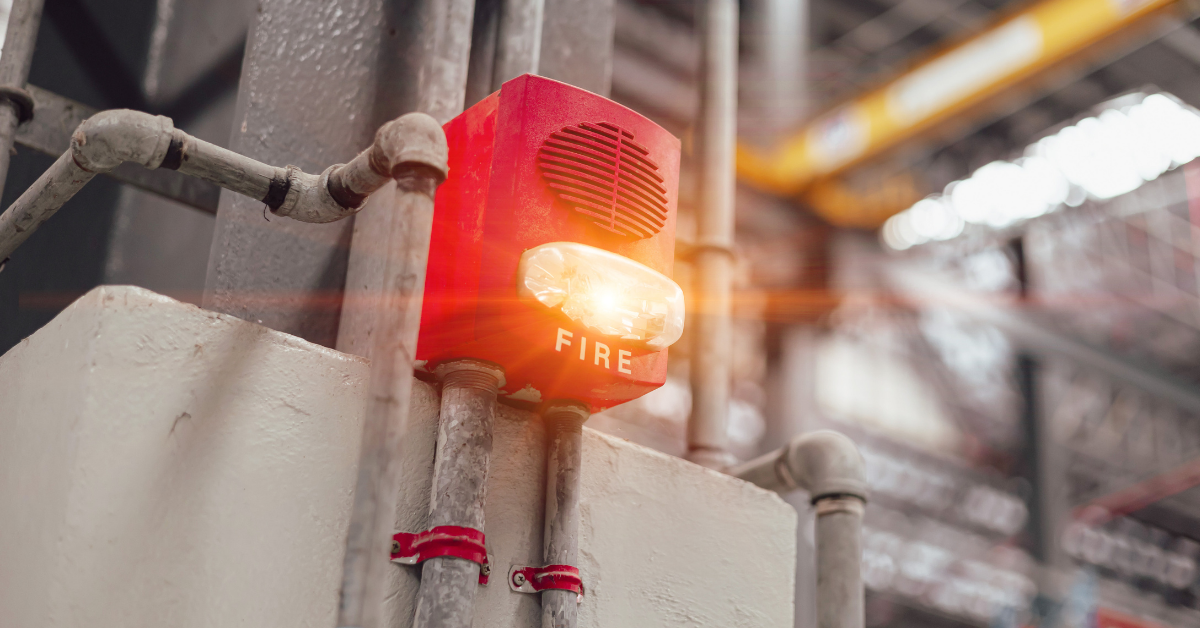
ULC-monitored fire alarm coverage is not a security upgrade, it is a regulatory and life-safety obligation, backed by a Canadian standard, tied to Ontario’s Building and Fire Codes, and increasingly enforceable through direct financial penalties. For an Ontario warehouse or logistics facility, the question is not whether the building has a fire alarm panel. It is whether that panel’s signals reach a certified monitoring station fast enough, reliably enough, and with documentation current enough to survive an inspection, an insurance renewal or an actual fire.
SecurU designs, installs, certifies and monitors CAN/ULC-S561-compliant fire alarm monitoring for commercial and industrial properties from its Puslinch office, serving Guelph, Cambridge, Kitchener-Waterloo, Milton, Burlington, Oakville, Hamilton, Mississauga, Caledon, Niagara and the GTA.
This article covers fire alarm monitoring and compliance specifically. For general warehouse security, cameras, access control, theft and insider-risk controls — see “Securing Warehouses in Ontario in 2026.”
What is CAN/ULC-S561 and does it apply to my warehouse?
CAN/ULC-S561 is the Canadian standard governing how fire alarm signals get from a building to a monitoring station, and how that monitoring station handles them once received. It applies to any building whose fire alarm or sprinkler supervisory system is required to be monitored under Ontario’s Building and Fire Codes — which, depending on a building’s size, occupancy and construction, commonly includes warehouses and distribution facilities.
In plain terms, CAN/ULC-S561 covers three things:
- Equipment: the transmitter at the building and the receiving equipment at the monitoring station must be manufactured and tested to a companion standard, CAN/ULC-S559.
- Signal transmission: a fire alarm signal must be prioritized above all other signal types and must reach the monitoring station’s Signal Receiving Centre (SRC) within 60 seconds of activation.
- Response: the SRC must dispatch the fire department within 30 seconds of receiving a genuine fire alarm signal, with no pre-verification step. Other conditions — trouble signals, supervisory signals — have a longer allowable window, typically up to five minutes.
The standard also governs the physical construction of the SRC itself: 24/7 staffing, backup power, fire-rated construction and controlled access, so the monitoring station is itself resilient during an emergency.
That “no pre-verification” rule is a meaningful difference from how many commercial intrusion alarms are handled, where a monitoring centre may attempt to verify an event before escalating to reduce false-alarm dispatches. Fire signals don’t get that step — a genuine fire alarm goes straight to dispatch.
How is monitored fire alarm coverage different from a standalone fire alarm system?
A standalone fire alarm system can detect smoke or heat and sound a local alarm without ever notifying anyone outside the building. A CAN/ULC-S561-monitored system adds a second, independent layer: the panel’s signal is transmitted to a staffed SRC, which is responsible for dispatching the fire department regardless of whether anyone inside the building calls 911.
For a warehouse, that second layer matters more than it does in most other occupancies. A local alarm depends on someone being close enough, and paying enough attention, to hear it and act. A large facility with a small overnight crew, a mezzanine storage area, or long aisles between the point of ignition and the nearest person removes that assumption. Monitoring doesn’t rely on anyone noticing, it puts the notification and dispatch decision in the hands of a system built specifically to do that within seconds, not minutes.
Who issues a ULC monitoring certificate, and why does my insurer or fire inspector ask for it?
The installer and the monitoring company both play a role, and both must be ULC Listed but they issue different documents.
- The installer submits a verification report confirming the system was installed and commissioned to the applicable standard.
- The ULC-Listed monitoring company — the one providing ongoing monitoring, inspection and service for the account — is the party that issues and maintains the ULC certificate.
That distinction matters practically. A building can have a fully installed, functioning fire alarm panel and still have no valid ULC certificate, if the monitoring arrangement behind it doesn’t meet CAN/ULC-S561, or if the certificate has lapsed because service or inspection requirements weren’t kept current. The certificate isn’t a one-time proof that the system was installed correctly — it’s an ongoing attestation that the monitoring relationship itself remains compliant.
A fire inspector or Authority Having Jurisdiction (AHJ — the official responsible for enforcing the applicable building or fire requirements) will typically ask to see the current ULC certificate as the recognized proof of compliant monitoring, rather than accepting an invoice or a verbal assurance. Insurers frequently ask for the same document during underwriting or renewal, for the same reason: it’s a specific, verifiable attestation rather than a general claim.
For how this ties into insurance underwriting, claims and renewal documentation specifically, see “Does Security Actually Lower Your Insurance Premiums? A 2026 Guide for Ontario Property Managers and Warehouse Owners.”
How often does fire alarm monitoring need to be recertified in Ontario?
As of January 1, 2026, this changed in a significant way. Ontario Regulation 87/25 amended the Ontario Fire Code to formally adopt two additional standards alongside CAN/ULC-S561:
- CAN/ULC-S536:2019 — Inspection and Testing of Fire Alarm Systems (the annual inspection of the fire alarm system itself)
- CAN/ULC-S537:2019 — Verification of Fire Alarm Systems (required whenever a system is newly installed or significantly modified)
In practice, that means an Ontario warehouse’s fire alarm compliance now rests on three related but distinct pieces, not one: the monitoring connection (CAN/ULC-S561), the annual inspection and testing of the system itself (CAN/ULC-S536), and verification whenever the system changes (CAN/ULC-S537).
The 2026 update also raised the documentation bar substantially. Annual inspections must now use standardized ULC-prescribed report formats rather than a contractor’s own checklist, and must include device-level results, a technician attendance log (who was on-site, when, for how long), and measured values. For example actual battery readings rather than a simple pass/fail. Deficiencies must be tracked separately from recommendations, with evidence of correction.
Inspection records must be retained at the building for at least two years. Ontario’s Electronic Commerce Act generally allows a digital record to satisfy a “written record” requirement, provided it’s accessible, retained, and kept in a stable form — so a well-managed digital compliance file is acceptable, but it needs to actually meet those conditions, not just exist somewhere in an inbox.
The stakes for getting this wrong went up at the same time. Ontario Regulation 260/25, also effective January 1, 2026, gives municipalities the authority to issue Administrative Monetary Penalties under the Fire Protection and Prevention Act for fire code violations — including missed inspections, incomplete documentation and unresolved deficiencies — up to $10,000 for an individual and $100,000 for a corporation. Documentation quality is no longer just an audit inconvenience; it’s now a direct, quantifiable financial exposure.
What’s specifically at risk in a warehouse or logistics facility?
Warehouses and distribution centres carry a fire-risk profile that’s meaningfully different from a typical office or retail occupancy, for a few concrete reasons:
- High fuel load: dense, high-piled rack storage concentrates far more combustible material in a given footprint than most other commercial occupancies, which can accelerate fire growth and complicate suppression.
- Mezzanine and racking layouts: multi-level storage can create pockets that are harder to see, harder for standard detection spacing to cover evenly, and harder for staff to physically reach.
- Forklift and material-handling equipment charging areas: lithium-ion batteries can enter thermal runaway if damaged, faulty or improperly charged, producing fires that are difficult to suppress and can reignite after they appear extinguished. Insurers increasingly recommend dedicated, compartmentalized charging areas separated from general storage rather than ad hoc charging wherever a forklift happens to be parked.
- Loading dock fire doors and openings: docks create large openings in an otherwise fire-separated envelope, and fire doors at those openings only provide their rated protection if they’re maintained, unobstructed and closing properly — a common inspection deficiency in busy dock environments.
The common thread across all four is staffing density. A downtown office fire is likely to be noticed by someone within seconds. A fire that starts in a rear rack aisle of a 200,000-square-foot distribution centre on an overnight shift with three people on-site may not be noticed by a person at all until it has grown considerably. That’s precisely the gap monitored, code-compliant fire alarm coverage is designed to close — detection and dispatch that doesn’t depend on a person being nearby.
What compliance gaps does SecurU commonly find in warehouses and DCs?
Most gaps aren’t the result of a facility having no fire alarm system. They’re the result of a monitoring or documentation arrangement that looks compliant but isn’t, once examined closely:
- Lapsed or missing ULC certificates — the system was compliant at installation, but the certificate wasn’t renewed as service or inspection requirements changed, or the facility can’t locate it when asked.
- Monitoring contracts that don’t actually meet CAN/ULC-S561 — the facility has a monitoring service, but it isn’t provided through a true ULC-Listed SRC meeting the standard’s response-time and construction requirements.
- Fire panels not connected through a supervised communication path — the connection between the panel and the monitoring station isn’t continuously supervised, so a communication failure could go undetected.
- Documentation that isn’t audit-ready — inspection records exist but aren’t in the standardized ULC report format, are missing the technician attendance log or device-level detail now required, or simply can’t be produced quickly when an AHJ or insurer asks.
Under the pre-2026 rules, several of these gaps might have gone unnoticed for years. Under the current inspection depth and the AMP framework described above, they’re now the kind of thing an inspector is specifically trained to look for — and the kind of thing that can result in a direct penalty rather than just a deficiency notice.
Fire monitoring as an ongoing service, not a one-time install
A fire alarm monitoring arrangement that was compliant on the day it was installed can become non-compliant over time without anyone changing anything on purpose — through a lapsed certificate, an inspection that was missed or under-documented, a panel modification that was never verified, or a monitoring contract that quietly stopped meeting the standard. Treating fire monitoring as a service relationship rather than a completed project is what keeps the certificate, the inspection records and the actual signal path all current at the same time.
SecurU designs, installs, certifies and monitors fire alarm systems in-house — the same team responsible for the CAN/ULC-S561-compliant monitoring connection also manages the certificate, coordinates annual CAN/ULC-S536 inspection and testing, and keeps documentation in the standardized, audit-ready format the 2026 rules require.
Frequently Asked Questions
[FAQ SCHEMA CANDIDATE — mark up with FAQPage structured data]
Is ULC-monitored fire alarm coverage legally required for all Ontario warehouses?
Not automatically for every building — it depends on the facility’s construction, occupancy and fire-protection design under Ontario’s Building and Fire Codes, and on what the local AHJ has determined applies to that specific property. Many warehouses and distribution facilities do fall under a monitoring requirement, but the applicable code section for a specific building should be confirmed with your AHJ rather than assumed from a general guide like this one.
What’s the difference between a fire alarm system and a ULC-monitored fire alarm system?
A fire alarm system detects smoke or heat and sounds a local alarm inside the building. A ULC-monitored system adds a second layer under CAN/ULC-S561: the panel’s signal is also transmitted to a staffed, ULC-Listed monitoring station, which is responsible for dispatching the fire department within 30 seconds of a genuine alarm — independent of whether anyone inside the building calls for help.
What happens during a fire inspection if I can’t produce a current ULC certificate?
The inspector cannot confirm the monitoring arrangement meets CAN/ULC-S561 without it, which is typically treated as a deficiency requiring correction. As of January 1, 2026, missed inspections, incomplete documentation and unresolved deficiencies can also result in a direct Administrative Monetary Penalty under Ontario Regulation 260/25 — up to $10,000 for an individual or $100,000 for a corporation — rather than only a notice to correct.
Does fire monitoring require pre-verification, the way some intrusion alarms do?
No. Unlike many commercial burglar-alarm responses, which may include a verification step before dispatch to reduce false alarms, CAN/ULC-S561 does not allow pre-verification for fire signals. A genuine fire alarm signal must be dispatched to the fire department within 30 seconds of receipt.
What happens to my ULC certificate if I switch monitoring providers?
The certificate is tied to the ULC-Listed monitoring company providing the service, so it doesn’t automatically transfer. A new monitoring provider needs to confirm the existing connection and equipment meet CAN/ULC-S561, complete any required verification, and issue its own current certificate under its own listing.
Does SecurU handle both the fire panel monitoring and the certification paperwork?
Yes. SecurU designs, installs, certifies and monitors fire alarm systems in-house, including issuing and maintaining the ULC certificate and coordinating the annual inspection and testing documentation required under CAN/ULC-S536 and S537.
Fire code requirements, AHJ determinations and insurance conditions vary by property. SecurU can confirm your facility’s current monitoring and certification status, but final code interpretation rests with your local AHJ, and insurance requirements should be confirmed with your broker or insurer.
Book a free fire monitoring compliance check with SecurU
Sources Cited
Standards Council of Canada — CAN/ULC-S561:2024
Fire Safety Solutions Canada — 2026 Ontario Fire Code Update: New Documentation RequirementsEnvironmental Registry of Ontario — Administrative Monetary Penalties framework under the FPPA (O. Reg. 260/25)
 Does Security Actually Lower Your Insurance Premiums? A 2026 Guide for Ontario Property Managers and Warehouse Owners